Everything you need to know about purchasing vacant land in South Carolina — geography, tax benefits, land types, financing, and due diligence.
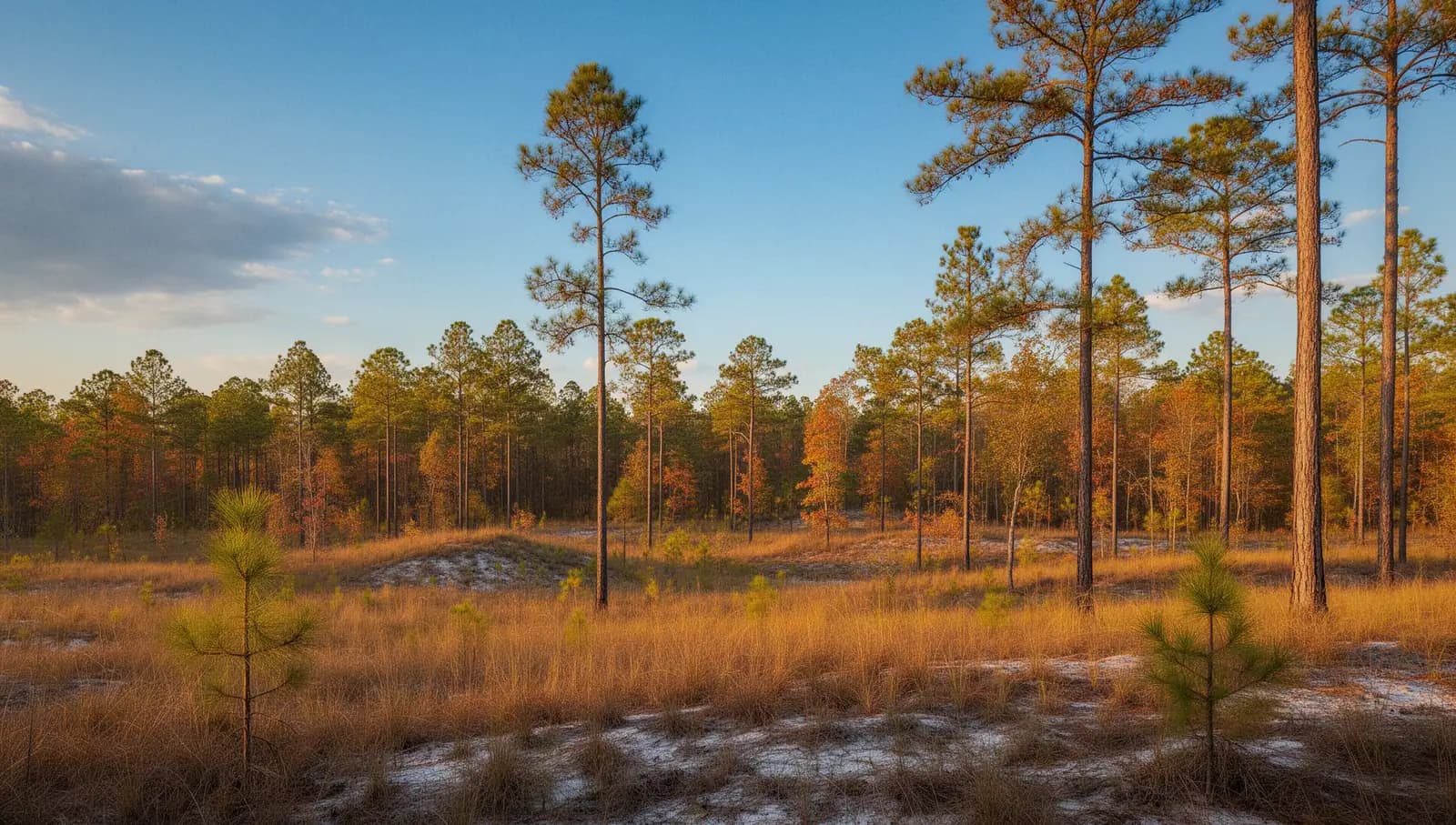
South Carolina runs from the Blue Ridge foothills through the rolling Piedmont and a belt of sandy Sandhills to a broad Coastal Plain that covers about two-thirds of the state (South Carolina Encyclopedia). Forest covers 12.8 million acres, or 67% of the land, and 87% of that forest is privately owned, with loblolly and shortleaf pine the most common type (USDA Forest Service, 2023 inventory). Farms cover about 4.55 million acres and grow mainly soybeans, corn, hay, cotton and wheat (USDA Census of Agriculture, 2022). For property tax, vacant land is assessed at 6% of market value, while a qualifying primary residence and up to 5 acres is assessed at 4%; timber tracts of at least 5 acres and other farm tracts of at least 10 acres can be valued on their agricultural use, with county assessor approval and rollback taxes if the use later changes (SC Department of Revenue). South Carolina has no estate or inheritance tax. Rules like these vary by county and change over time, so the county assessor and a real estate attorney can confirm how they apply to a specific parcel. As of November 2026, 3 parcels are listed on Acre Dreams in South Carolina, 3 to 10 acres at $35,000 to $89,900 cash, all with owner financing.
Pine timberland
loblolly and shortleaf
Mixed hardwood and oak-hickory forest
Row-crop farmland (soybeans
corn
cotton
peanuts)
Pasture and hay land
Sandhills tracts with sandy well-drained soils
Rolling Piedmont acreage
Hunting and recreational land
Rural homesites
There are currently 3 parcels available across 1 county, totaling 18 acres.
$9,489
Avg $/Acre
1
County
100%
Offer Financing
18
Total Acres
| County | Listings | Avg $/Acre | Avg Price |
|---|---|---|---|
| Marlboro | 3 | $9,489 | $56,933 |
Owner financing is one of the most buyer-friendly aspects of the vacant land market. The seller acts as the lender — you make a down payment and pay the rest over time, with no bank approval required. Currently, 100% of South Carolina listings on Acre Dreams offer owner financing.
Owner financing makes land ownership accessible even if you don't qualify for a traditional mortgage. Look for the “Owner Financing Available” badge when browsing listings.
Before purchasing any land in South Carolina, complete these essential steps to protect your investment:
Check South Carolina county assessor records to confirm the seller is the legal owner. Get a title search to uncover liens, easements, or encumbrances. For purchases over $5,000, title insurance is recommended.
Verify the property has legal road access — either public road frontage or a recorded easement. Use satellite imagery to confirm physical access matches legal descriptions. In rural South Carolina, some parcels may be landlocked.
Contact the county planning department to confirm permitted uses. Can you build? Are manufactured homes allowed? What are setback requirements? Zoning rules vary by county in South Carolina.
Check FEMA flood maps for the parcel. Zone X means minimal risk. Zones A and AE carry higher flood risk and may require insurance for structures.
Check the county tax collector for current annual taxes and any delinquent amounts. Vacant land taxes are typically low, making land one of the cheapest assets to hold long-term.
South Carolina offers a wide range of land, from Piedmont hills to Pee Dee farmland and Sandhills pine country, and its property taxes on homes are low: the effective rate on owner-occupied housing was 0.47% in 2023, 47th among the states (Tax Foundation). Vacant land is assessed at a higher ratio than a home, so its tax bill is usually higher. Before buying, check road access, the flood zone, and whether the site can get a septic permit. As of November 2026, 3 parcels are listed on Acre Dreams in South Carolina, 3 to 10 acres at $35,000 to $89,900 cash, all with owner financing.
In general, the county multiplies the land's market value by the 6% assessment ratio and then by the local millage. The 4% ratio applies only to a qualifying primary residence and up to 5 acres, after the assessor approves an application, and qualifying farm and timber land can be valued on agricultural use instead. The county assessor and treasurer can tell you a specific parcel's classification and last tax bill.
Yes. Property without public or community sewer needs site approval and a permit from the SC Department of Environmental Services before a septic system is installed, and the county won't issue a building permit without it. The application fee is $150 and permits to construct are valid for five years. Sites above the Fall Line need backhoe pits for the soil evaluation.
Yes. South Carolina has no landowner exemption, so people hunting their own land need the applicable licenses, permits and tags; only hunters under 16 are exempt. A resident annual hunting license is $12 and the big game permit for deer, turkey and bear is $6 (SCDNR, 2026-27). Seasons vary by game zone, and Marlboro County is in Game Zone 4.
South Carolina charges a deed recording fee of $1.85 for each $500 of value ($3.70 per $1,000), made up of a $1.30 state fee and a $0.55 county fee, plus a $15 filing fee to record the deed. The law places the recording fee on the seller, although who pays is often agreed in the sales contract.
Browse available properties across 1 counties in South Carolina. Many offer owner financing with no credit check.
Browse South Carolina Land